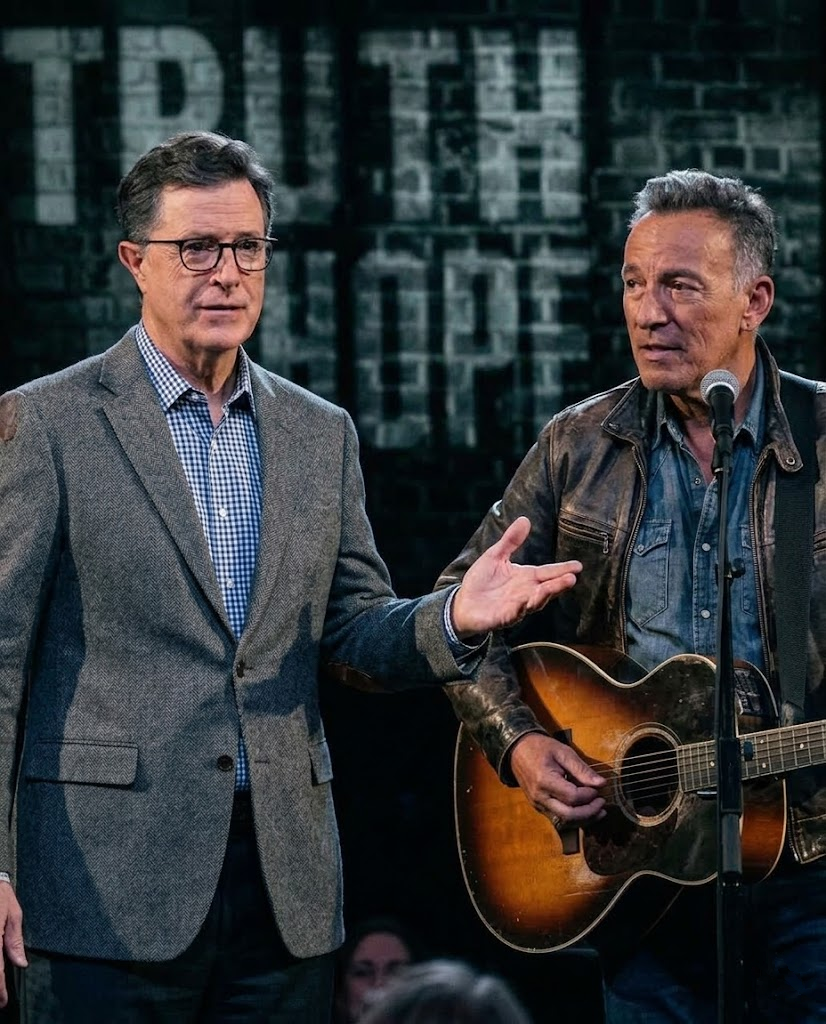
“YOU’RE THE FIRST GUY IN AMERICA WHO LOST HIS SHOW BECAUSE WE’VE GOT A PRESIDENT WHO CAN’T TAKE A JOKE.”

The room was already emotional before Bruce Springsteen even touched the guitar.
Everyone inside the Ed Sullivan Theater knew what night it was.
Stephen Colbert’s second-to-last episode of The Late Show.
After nearly eleven years behind the desk, more than 1,600 episodes, and an era of late-night television shaped by political satire, cultural chaos, celebrity interviews, viral monologues, and deeply personal moments, the end was suddenly standing directly in front of everyone.
And somehow, despite all the famous guests arriving to celebrate Colbert’s farewell week, the atmosphere Wednesday night did not feel celebratory.
It felt heavy.
The kind of emotional heaviness that settles into a room when people know something larger than a television show is disappearing.
Then Springsteen walked out alone.
Acoustic guitar.
Harmonica around his neck.
No elaborate production.
No theatrical entrance.
Just one man carrying decades of American music history onto a stage preparing for its final goodbye.
And within seconds, he said the thing Stephen Colbert himself never directly said.
A Silence Colbert Never Broke Himself
Throughout the final weeks of The Late Show, Stephen Colbert had largely avoided turning his cancellation into bitterness.
He joked.
He smiled.
He thanked audiences.
He welcomed guests with warmth and restraint.
Even as speculation exploded online about why CBS chose to end one of the most recognizable late-night franchises in television history, Colbert himself remained surprisingly careful.
He never fully unleashed anger publicly.
Never directly framed himself as a victim.
Never turned his farewell into a public war.
That restraint became part of the emotional tension surrounding the show’s final days.
Because audiences could sense there were things left unsaid.
Then Bruce Springsteen arrived and shattered the silence.
“This Is for You, Stephen.”
Springsteen stepped to the microphone and immediately made clear this would not be a nostalgic musical appearance.
“I am here in support tonight for Stephen,” he began.
Then came the line that instantly electrified the theater:
“You’re the first guy in America who lost his show because we’ve got a president who can’t take a joke.”
The audience reacted immediately.
Gasps.
Applause.
Shock.
Some people laughed nervously.
Others simply froze.
Because whether viewers agreed with him politically or not, everyone understood instantly what Springsteen was doing.
He was saying publicly what Colbert himself had carefully avoided saying directly.
He Named the Ellisons Directly
But Springsteen did not stop there.
He specifically referenced Larry and David Ellison — the billionaire family connected to Paramount’s leadership structure following corporate changes involving CBS and Skydance.
The remarks stunned viewers precisely because they happened live on CBS itself.
No softening.
No cautious phrasing.
No vague corporate language.
Springsteen framed the cancellation as something larger than ratings or financial restructuring.
To many viewers, it sounded less like celebrity commentary and more like open accusation.
And the tension inside the room reportedly shifted immediately afterward.
The Theater Went Quiet
What happened next surprised many people even more.
The audience did not explode into applause for long.
Instead, a strange silence settled across the room.
Not awkwardness.
Something heavier.
Because Springsteen was no longer functioning as entertainment.
He was speaking emotionally, politically, and personally all at once.
And suddenly the farewell week for The Late Show no longer felt like ordinary television nostalgia.
It felt like cultural mourning.
Then Came Five Quiet Words
Springsteen paused.
Looked toward Colbert.
Then said softly:
“This is for you, Stephen.”
Five simple words.
But people inside the theater later described the emotional atmosphere changing instantly afterward.
Because everyone suddenly understood the performance was not intended as routine promotion.
It was tribute.
Solidarity.
Maybe even protest.
“Streets of Minneapolis” Changed the Entire Mood
Then Springsteen began performing Streets of Minneapolis.
The song itself already carried enormous political and emotional weight before Wednesday night.
Written as a protest anthem responding to deaths connected to ICE operations in Minneapolis, the song had already sparked major national discussion months earlier.
But inside the Ed Sullivan Theater Wednesday night, stripped down to one guitar and one voice, the song transformed into something even more intimate.
No band thunder.
No arena spectacle.
Just Springsteen singing like a man trying to preserve something before it disappeared forever.
The American Flag Behind Him Changed Everything
One of the most haunting visual details of the performance came from the stage design itself.
Behind Springsteen, an American flag glowed across a brick wall.
Words reportedly appeared behind him during the performance:
“RESISTANCE.”
“TRUTH.”
The imagery was stark.
Minimal.
Powerful.
Not flashy patriotism.
Something sadder.
A visual reminder that arguments about freedom, protest, satire, media, and political pressure were now colliding directly inside one of television’s most historic theaters.
Springsteen Didn’t Perform Like a Celebrity
Many viewers later noted how different Springsteen seemed emotionally during the appearance.
This did not feel like a superstar arriving to enjoy applause.
He looked serious.
Focused.
Almost burdened.
At 76 years old, Springsteen has spent decades using music as political and emotional commentary.
But Wednesday night felt uniquely personal.
Like he understood the performance itself might become part of television history.
Colbert’s Expression Said Everything
Throughout the performance, cameras occasionally returned to Colbert.
And viewers immediately noticed something different about his expression.
He smiled softly at times.
But there was visible emotion underneath it.
Not exaggerated television emotion.
Real restraint.
The look of someone allowing another person to say publicly what he himself could not fully say.
That emotional dynamic transformed the performance into something far more intimate than ordinary television.
The End of an Era Suddenly Felt Real
For months, discussions about the decline of late-night television had remained mostly theoretical.
Ratings conversations.
Corporate restructuring.
Streaming competition.
Audience fragmentation.
But Wednesday night made the ending feel painfully human.
Because suddenly viewers were not watching an industry shift abstractly.
They were watching people mourn something they genuinely loved.
Why the Moment Hit So Hard Online
Clips from the appearance spread across social media within minutes.
And reactions exploded immediately.
Some praised Springsteen’s courage.
Others criticized the political framing.
But nearly everyone agreed on one thing:
The moment felt emotionally raw in a way modern television rarely allows anymore.
One viral reaction simply read:
“Springsteen didn’t come to entertain. He came to defend his friend.”
Another wrote:
“This felt less like a musical performance and more like witnessing someone deliver a eulogy.”
That emotional interpretation spread rapidly online.
Late-Night Television Used to Feel Permanent
Part of the sadness surrounding Colbert’s departure comes from what late-night television once represented culturally.
For generations, hosts like Johnny Carson, David Letterman, Jay Leno, Conan O’Brien, Jon Stewart, and Stephen Colbert became nightly companions for millions of Americans.
People built routines around those shows.
Processed politics through them.
Laughed through difficult periods of life because of them.
The idea that The Late Show itself could disappear entirely still feels surreal to many viewers.
Springsteen and Colbert Share Something Important
Part of what made Wednesday night resonate so deeply involved the connection between Springsteen and Colbert themselves.
Both men built careers rooted partly in speaking uncomfortable truths through performance.
Springsteen through music.
Colbert through satire.

Both understand how humor and storytelling can expose deeper anxieties inside American culture.
And both understand the emotional cost that can come with refusing silence.
That shared understanding hung over the entire performance.
The Ed Sullivan Theater Has Seen Generations Pass Through
The location itself added another layer of emotional power.
Ed Sullivan Theater has hosted generations of television history.
From Ed Sullivan introducing The Beatles to David Letterman reinventing late-night television there in 1993, the building became part of America’s entertainment identity itself.
Now audiences are preparing emotionally to watch the theater go dark for good.
That reality haunted Wednesday night.
“Burning Down the House” Was Joy. This Was Something Else.
Only one night earlier, David Byrne and Colbert danced wildly to Burning Down the House in what many viewers interpreted as joyful release before the ending.
Wednesday night carried the opposite emotional energy.
Not celebration.
Confrontation.
Reflection.
Grief.
If Byrne’s appearance felt like one final dance before the lights went out, Springsteen’s performance felt like someone standing in the ruins afterward trying to explain what was lost.
Music Sometimes Says What Television Cannot
One reason the performance resonated so powerfully is because music often bypasses institutional caution entirely.
Executives can shape interviews.
Networks can manage narratives.
Publicists can soften controversy.
But one man with a guitar speaking emotionally from conviction remains difficult to control.
Wednesday night proved that.
Springsteen transformed a late-night appearance into political commentary, artistic protest, emotional tribute, and cultural critique simultaneously.
The Audience Didn’t Know How to React at First
Several viewers later observed that applause inside the theater felt delayed after portions of the performance.
Not because audiences disliked it.
Because people were emotionally processing what they were witnessing in real time.
Entertainment usually signals clearly how viewers should respond.
Wednesday night blurred those boundaries completely.
Was this music?
Political speech?
A goodbye?
A warning?
A tribute?
The answer somehow became all of them simultaneously.
Springsteen Has Always Understood Working-Class Grief
Part of what made the performance feel authentic is that Springsteen has spent decades writing about American disillusionment, struggle, economic anxiety, violence, political betrayal, and ordinary people carrying emotional burdens.
Songs like Born in the U.S.A., The River, Youngstown, and American Skin (41 Shots) all explored the tension between American ideals and painful realities.
Streets of Minneapolis fits directly into that tradition.
And Wednesday night, it became tied forever to Colbert’s farewell.
One Man Said What Another Couldn’t
Perhaps the most powerful aspect of the entire evening involved emotional substitution.
Colbert remained gracious.
Measured.
Controlled.
Springsteen arrived and expressed the anger, frustration, and accusation many viewers suspected had existed quietly beneath the surface all along.
That emotional exchange gave the performance extraordinary weight.
Because it no longer felt like celebrity solidarity.
It felt personal.
Why People Are Calling It the Real Goodbye
Even though Colbert’s final episode still remained ahead, many viewers online immediately described Wednesday night as the true emotional climax of the farewell week.
Not because of spectacle.
Because of honesty.
People sensed authenticity underneath every moment.
And in modern television culture, authenticity has become increasingly rare.
The Room Never Fully Recovered Emotionally
After Springsteen finished performing, viewers noticed something subtle but important.
The atmosphere inside the theater never completely returned to normal.
The emotional gravity remained hanging over everything afterward.
Because once certain truths enter a room publicly, they cannot easily be pushed back out again.
Television Rarely Feels This Alive Anymore
Modern entertainment often feels over-managed.
Over-produced.
Carefully optimized.
But Wednesday night felt dangerous in the old-fashioned sense.
Unpredictable.
Emotionally exposed.
Alive.
The kind of television moment people immediately understand they will still remember years later.
One Last Act of Refusal Before the Curtain Falls
Ultimately, Bruce Springsteen’s appearance was not just about politics.
Or corporations.
Or even Colbert alone.
It was about refusing silence during a moment that felt emotionally important.
Refusing to let an era end quietly.
Refusing to pretend the goodbye carried no larger meaning.
And standing onstage with a guitar to say publicly what another man could not fully say himself.
The Moment That Will Likely Outlive the Show
Years from now, audiences may forget many details surrounding the final week of The Late Show.
But they will probably remember this:
Bruce Springsteen alone beneath dim lights.
An acoustic guitar.
An American flag glowing behind him.
Stephen Colbert watching silently.
And one sentence hanging permanently in the air above the Ed Sullivan Theater:
“You’re the first guy in America who lost his show because we’ve got a president who can’t take a joke.”