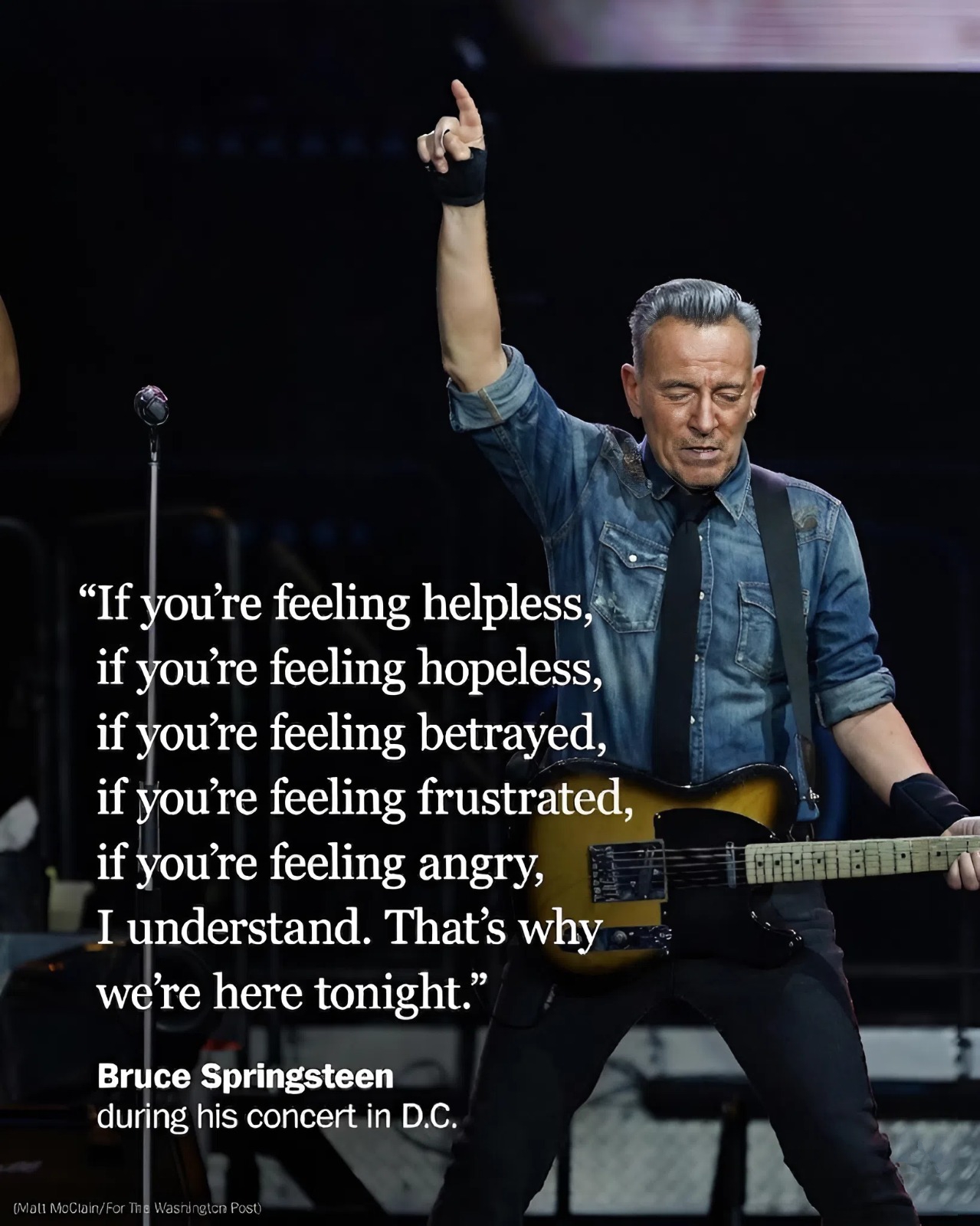
Bruce Springsteen turned another concert into a powerful political statement Friday night as he took the stage at Nationals Park in Washington, D.C., delivering a performance that blended music, activism, and a call for civic engagement. The show, one of the final stops on a tour that has increasingly been framed as an act of resistance against President Donald Trump, drew thousands of fans who came not only to hear classic songs but also to witness Springsteen’s latest message about democracy, unity, and public action.
The concert marked the second-to-last performance of the tour, and the atmosphere reflected both celebration and determination. Fans packed the stadium hours before showtime, many carrying signs and wearing shirts featuring messages about voting rights, equality, and social justice. While Springsteen has never shied away from expressing his political views, recent performances have taken on an even more urgent tone as he continues to speak out on issues he believes are shaping the future of the United States.

Throughout the evening, Springsteen mixed beloved hits with passionate commentary about the state of the nation. Between songs, he addressed the crowd with the same directness that has defined much of his public life, encouraging people to remain engaged in their communities and to use their voices in defense of democratic values.
“This country belongs to its people,” Springsteen told the audience. “The future isn’t something that happens to us. It’s something we create together.”
The statement was met with loud applause from thousands of fans, many of whom have followed Springsteen for decades and view his music as deeply connected to the experiences of working Americans. Known for songs that explore economic struggles, family life, hope, and resilience, Springsteen has long positioned himself as a storyteller for everyday people.
However, one of the evening’s most significant moments came when the legendary musician announced the launch of a brand-new event aimed at extending that message beyond the concert stage.

Springsteen revealed plans for the first-ever Power to the People Festival, scheduled to take place in Washington, D.C., on October 3. According to the announcement, the festival will bring together musicians, activists, community leaders, and organizations focused on civic participation and social engagement.
The crowd erupted as the news was shared.
“This is about more than politics,” Springsteen explained. “It’s about community. It’s about participation. It’s about reminding people that democracy is something we practice every day.”
While details about performers and speakers have yet to be fully released, organizers say the event will focus on encouraging voter participation, supporting local initiatives, and fostering dialogue across communities. The festival is expected to feature live music, educational programming, and opportunities for attendees to connect with advocacy groups and nonprofit organizations.
For many fans, the announcement felt like a natural extension of Springsteen’s career-long commitment to social issues.
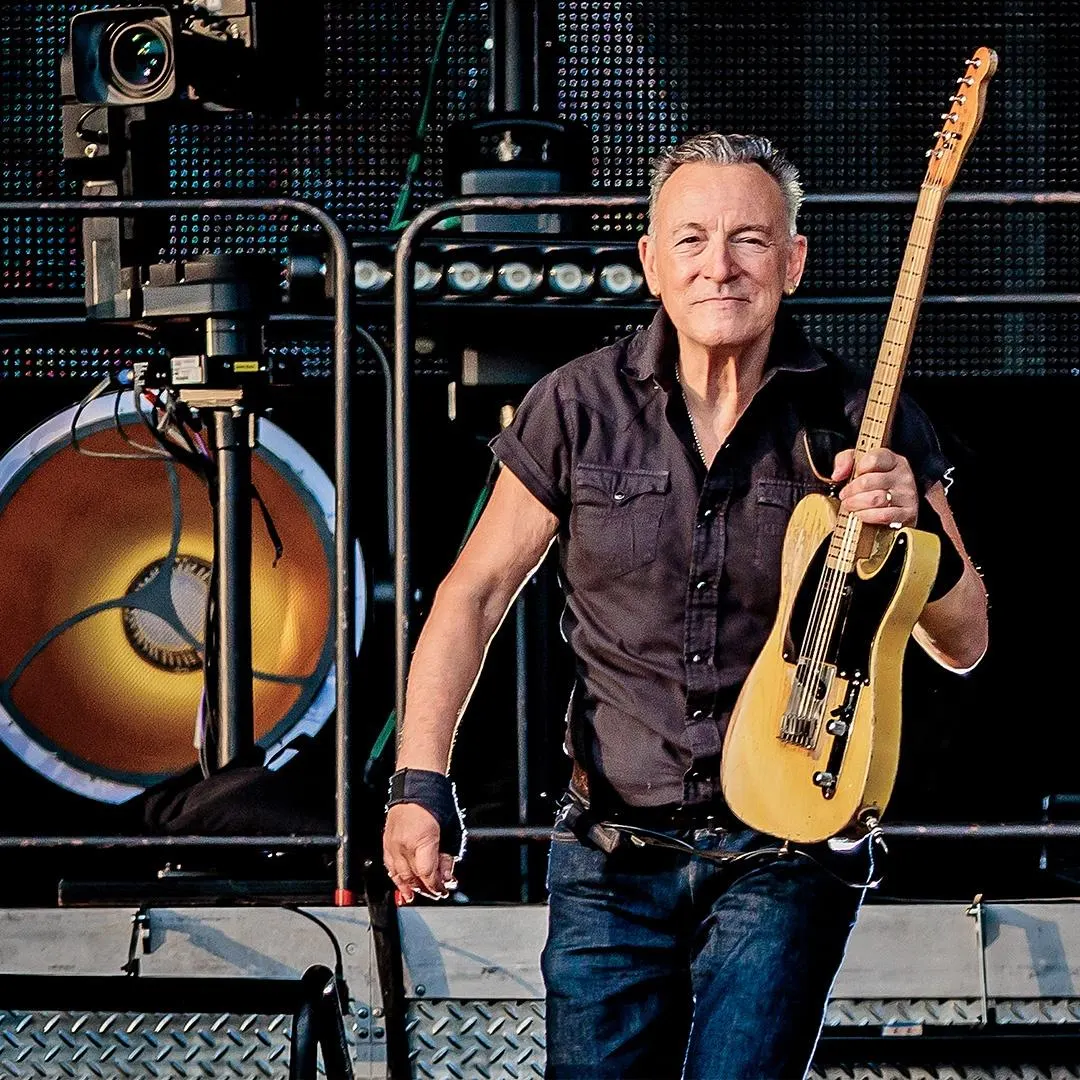
Over the decades, Springsteen has become one of America’s most recognizable voices not only in music but also in public life. From advocating for veterans and working families to supporting disaster relief efforts and community organizations, he has frequently used his platform to draw attention to causes he believes matter.
That commitment has often placed him at odds with political leaders, including President Trump. The two have exchanged criticism for years, with Springsteen repeatedly expressing concern about what he views as growing divisions in American society. Trump, meanwhile, has responded publicly on several occasions, criticizing the musician and dismissing his political commentary.
Despite the controversy, Springsteen’s supporters argue that speaking out has always been part of who he is.
“Bruce has never separated music from real life,” said one fan who traveled from Pennsylvania to attend the concert. “The songs are about people, and the issues he talks about affect people. For a lot of us, that’s why his music still matters.”
Others in attendance described the concert as both inspiring and emotional.
“It felt like more than a show,” another attendee said. “It felt like a reminder that people still have the power to make a difference.”
The setlist reflected that spirit, combining energetic rock anthems with reflective ballads that highlighted themes of perseverance and hope. Audience members sang along to nearly every song, creating moments of collective energy that echoed throughout the stadium.
 As the night continued, Springsteen repeatedly returned to the idea of participation. Rather than focusing solely on national politics, he encouraged fans to become involved at the local level, emphasizing the importance of community organizations, neighborhood projects, and volunteer efforts.
“Change doesn’t start in Washington,” he said at one point. “It starts where you live. It starts with your neighbors. It starts with ordinary people deciding they care enough to act.”
That message appeared to resonate strongly with the audience, many of whom viewed the concert as both entertainment and a call to action.
Political activism among artists has become increasingly visible in recent years, with musicians across multiple genres using their platforms to address issues ranging from climate change and racial justice to voting rights and economic inequality. Springsteen remains one of the most prominent examples of that trend, particularly because of his long-standing reputation as a voice for working-class Americans.
Whether supporters agree with every position he takes or not, few dispute the impact he continues to have. More than five decades into his career, Springsteen remains capable of filling stadiums, generating headlines, and sparking conversations that extend far beyond the music industry.
As the concert came to a close, fans left Nationals Park energized by both the performance and the announcement of the upcoming festival. For many, the evening represented a continuation of the themes that have defined Springsteen’s work for generations: hope in difficult times, faith in ordinary people, and the belief that communities can shape their own future.
With the Power to the People Festival now on the horizon and the tour nearing its conclusion, Springsteen appears determined to carry those themes forward. Whether through music, activism, or public engagement, he continues to challenge audiences to think beyond the concert stage and consider their role in the larger story of American democracy.
For Bruce Springsteen, the final chapters of this tour are not simply about looking back on a legendary career. They are about encouraging people to look ahead—and to recognize the power they still have to shape what comes next.


