On March 16, 1991, the life of country music icon Reba McEntire changed forever.
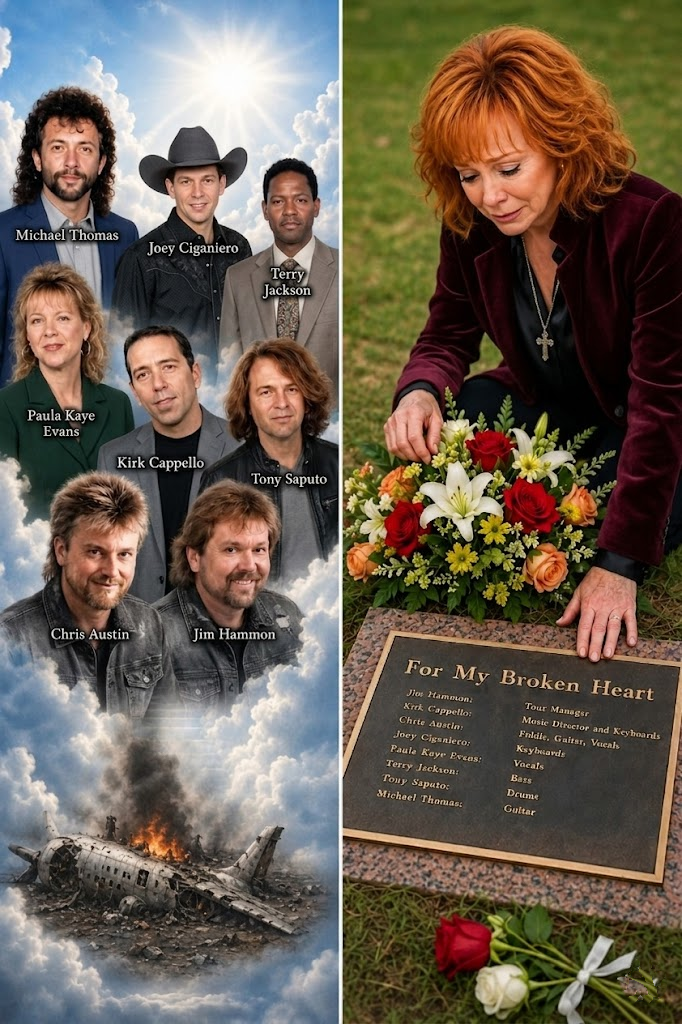
Just hours after performing a private concert in San Diego, two planes were arranged to carry members of her band and crew to their next destination. Reba, along with her husband and stylist, planned to travel separately the following morning. But shortly after takeoff, tragedy struck. One of the planes crashed into Otay Mountain in California, killing everyone on board.
In a single moment, Reba lost eight members of her touring family.

The people who died that night were far more than employees or fellow musicians. They were the faces she saw every day on the road, the friends who stood beside her through endless rehearsals, late-night bus rides, sold-out arenas, laughter backstage, and the exhausting rhythm of life on tour. They had built a life together over years of performing, traveling, and chasing dreams across America. Reba trusted them, leaned on them, and loved them deeply.
When the news reached her, those close to the singer later described her as completely shattered. The grief was immediate, overwhelming, and impossible to fully process. For someone whose career had always been built around connection, loyalty, and heart, the loss cut unimaginably deep.
And yet, only days later, Reba returned to the stage to perform at the Academy Awards.
To many people watching, it was a display of incredible strength. But beneath the professionalism and composure was a woman carrying unbearable pain. She later admitted that during that period, simply getting through each day felt emotionally exhausting. The world continued moving forward around her, but nothing in her own life felt normal anymore.
Rather than disappearing completely from music, Reba did what many great artists do in moments of devastation — she turned to music as a way to survive.
Out of that grief came For My Broken Heart, the album that would become one of the most emotional and defining projects of her entire career.
Reba later explained that the album became “a form of healing for all our broken hearts.” And listeners could feel that honesty in every note.
This was not an album created from imagination or storytelling alone. It came directly from real pain. Every lyric carried the weight of loss, loneliness, confusion, heartbreak, and the difficult process of learning how to continue after tragedy. During recording sessions, musicians and producers working with her reportedly noticed how emotionally heavy the atmosphere was. Reba herself admitted she simply was not emotionally capable of recording cheerful songs at that time.
The sorrow was too real.
Songs like For My Broken Heart resonated deeply because they spoke to something universal: the shock of losing someone without warning. The silence that follows. The empty spaces people leave behind. The strange feeling of waking up the next morning while the world continues as if nothing happened.
Another song, If I Had Only Known, carried an especially painful emotional weight. Its lyrics reflected the heartbreaking thoughts so many grieving people experience — wishing for one more conversation, one more goodbye, one more chance to say “I love you.”
Millions of listeners connected with the album not because it was polished or dramatic, but because it was honest. People who had experienced death, loss, divorce, illness, or tragedy recognized something authentic in Reba’s voice. She wasn’t simply singing country songs. She was processing grief in front of the world.
And in doing so, she unknowingly helped others process their own.
The album became a massive commercial success, but for Reba, its importance went far beyond sales or awards. It represented survival. It became proof that heartbreak could be transformed into something meaningful — something capable of comforting people who felt alone in their pain.
Over three decades later, Reba still speaks openly about the tragedy and the people she lost that night.
Time may soften certain wounds, but some losses never fully disappear. Reba has often said that the experience permanently changed her perspective on life, relationships, gratitude, and love. After enduring such sudden devastation, she learned not to take moments or people for granted.
The grief never truly left her.
She simply learned how to carry it.
And perhaps that is what makes her story so powerful. Reba McEntire did not “move on” from tragedy in the simple way people often expect. Instead, she carried the memory of those she loved into every performance, every song, and every year that followed. Through music, interviews, and public remembrance, she made sure their lives would continue to matter.
Even today, fans still revisit For My Broken Heart not only because of its music, but because of the story behind it — a story about love, loss, resilience, and healing through art.
What happened on March 16, 1991, remains one of the most heartbreaking tragedies in country music history. But it also revealed something extraordinary about Reba McEntire: even in the darkest moment of her life, she found a way to turn pain into connection, sorrow into comfort, and grief into something that continues touching hearts decades later.
And because of that, the people she lost will never truly be forgotten. ❤️🕊️