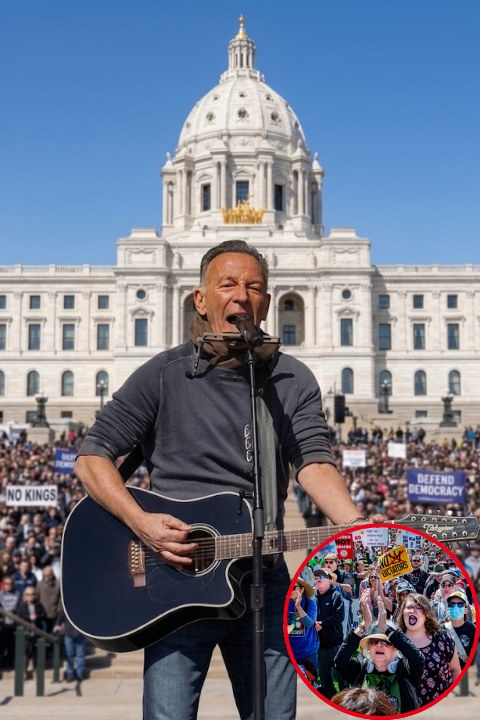
A concert became a statement, and a rally became something larger than anyone expected when Bruce Springsteen brought his “Land of Hope and Dreams American Tour” to the steps of the Minnesota State Capitol on March 28, transforming music into a powerful expression of civic energy.
What unfolded in St. Paul was not just another stop on a tour.
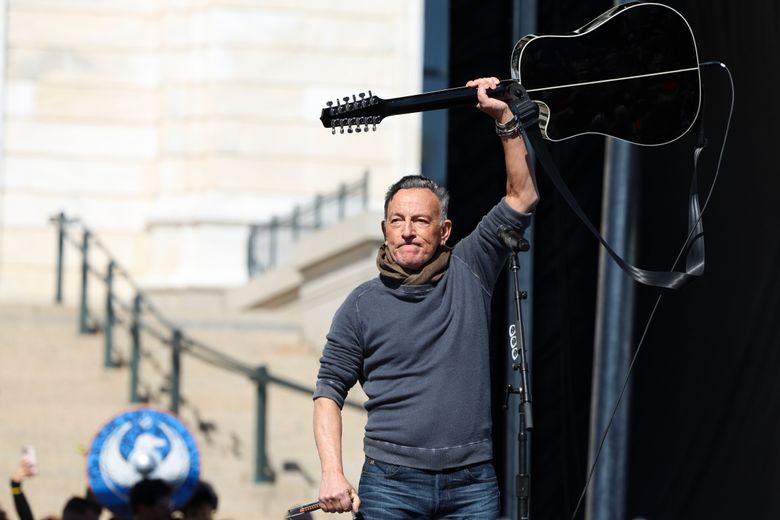
It was a moment where performance and purpose merged, as approximately 200,000 people gathered for the flagship “No Kings” rally, creating a scene that felt both historic and immediate. The scale alone signaled that this was more than entertainment, but it was Springsteen’s presence that helped define the tone of the day.
From the outset, the event carried a sense of urgency.
Crowds filled the surrounding streets, bringing with them signs, voices, and a shared understanding that the gathering represented something beyond a single issue. When Springsteen stepped forward, he did not separate himself from that energy. Instead, he became part of it, using his music as a way to connect with what was already building.
At the center of his performance was “Streets of Minneapolis,” a song that has increasingly come to symbolize reflection and response within the current cultural climate.
Delivered not in a traditional concert setting but on the steps of a government building, the performance took on a different meaning. It was no longer just a song, but a statement shaped by its surroundings, its audience, and the moment in which it was heard.
Observers noted the shift immediately.

There was no clear boundary between stage and crowd, between artist and audience. The music moved through the gathering as part of a larger expression, reinforcing the idea that the event itself was a collective act rather than a series of individual performances.
Springsteen’s appearance was one of many.
The rally also featured a diverse lineup of artists and speakers, including Joan Baez, Maggie Rogers, Tom Morello, Venus DeMars, Larry Long, Kashimana, Thomasina Petrus, and Secret Rivers, among others. Each contributed to a program that blended music, speech, and presence into a unified experience.
What made the event stand out was not just who appeared, but how it felt.
Participants described an atmosphere that was both intense and focused, where the purpose of the gathering shaped every moment. The term “Rock ’n’ Rebellion,” used to describe Springsteen’s tour, seemed to take on a literal meaning as music became a vehicle for expressing ideas tied to democracy, participation, and public voice.
In a brief moment during his appearance, Springsteen addressed the crowd in a way that reflected his long-standing connection to themes of civic engagement.
“This is about showing up… and making sure your voice is part of the story.”

The message aligned with the broader tone of the rally.
It emphasized participation, not just as a concept, but as an action, reinforcing the idea that moments like this extend beyond the event itself. For many in attendance, the gathering was not an endpoint, but a beginning, a signal that what happens in public spaces can carry forward into other forms of engagement.
The visual impact of the event also played a role in its significance.
Images of the crowd, stretching across the Capitol grounds and beyond, quickly circulated, underscoring the scale and intensity of the moment. The numbers alone became part of the narrative, offering a visible representation of the energy that defined the day.
Yet beyond what was captured on camera, there were elements that continued to resonate afterward.
Attendees spoke of conversations, connections, and moments that were not part of the official program, details that added depth to the experience and shaped how it would be remembered.
For Springsteen, the event represented a continuation of a career-long pattern.
He has consistently used his platform to explore the intersection of music and society, often bringing attention to themes that extend beyond the stage. In St. Paul, that approach took on a new dimension, as the performance became inseparable from the moment itself.
As the tour moves forward, the question remains how this blend of music and message will continue to evolve.
What is already clear, however, is that the St. Paul rally has set a tone that is difficult to ignore.
It was not just a concert.
It was not just a gathering.
It was a moment where sound, space, and purpose came together to create something that felt larger than all of them combined — a reminder that when music meets movement, the result can echo far beyond a single day.