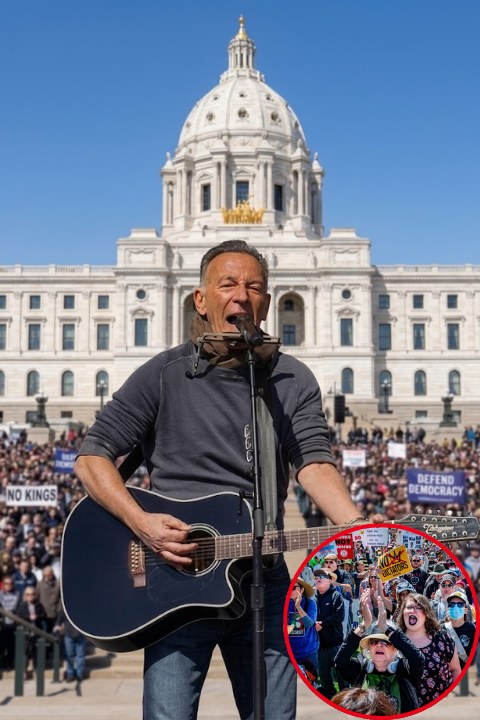
Less than twelve hours after Bruce Springsteen stepped onto the stage and made it unmistakably clear that this tour was about more than guitars and nostalgia, the internet was already in flames.
The question spread fast, bouncing from social feeds to group chats to late-night opinion panels:
How can anyone call this “just a concert” when he’s using stadium speakers to speak directly to the fragile core of American democracy?
Springsteen didn’t warm up slowly. He didn’t hide behind a greatest-hits buffer or let the crowd settle into comfort first. He went straight for the nerve. Before the first chorus had a chance to echo across the arena, he framed the night as something larger than entertainment. Freedom, he reminded the crowd, is not an heirloom passed down untouched. It is defended, tested, reshaped, and reclaimed—again and again, generation after generation.
Then he launched into the music like it was a mission.
Within minutes, clips began circulating online. But they weren’t going viral because of fireworks, celebrity cameos, or surprise covers. They were spreading because of what he said between songs. People weren’t reposting choruses. They were reposting warnings.

The hashtag #LandOfHopeAndDreams surged as debates ignited in comment sections. Some called it the most important American tour in years. Others accused Springsteen of crossing a line, arguing that music should unite, not divide. But even critics couldn’t deny the intensity of the moment.
Because this wasn’t vague symbolism.
Springsteen’s message was direct: democracy is not a background setting. It is not a permanent fixture guaranteed by history. It is a living system, and living systems can weaken. They can erode when people grow numb. They can fracture when division becomes identity. They can fade when citizens are convinced their voices don’t matter.
In Springsteen’s telling, this tour isn’t just traveling city to city—it’s casting a spotlight across the country. It’s forcing conversations into arenas where political talk is usually drowned out by slogans, fatigue, or indifference.
He isn’t performing at America.
He’s confronting it.
He’s not simply singing about dreams.
He’s asking who still believes in them.
That distinction matters. For decades, Springsteen’s music has wrestled with the American promise—the tension between the myth and the lived experience. From factory floors to small-town streets, from veterans’ struggles to working-class resilience, his catalog has always hovered near the fault lines of national identity. But this tour feels sharper, more urgent.
The undertone isn’t nostalgia. It’s alarm.
Freedom, he suggests, doesn’t disappear with tanks in the streets. It can be chipped away quietly. It can be diluted by cynicism. It can be sold off through apathy. It can be strangled by the quiet, persistent belief that “nothing will change anyway.”
That idea—resignation as a slow poison—is the real antagonist of the show.
When he moves into “Land of Hope and Dreams,” the lyrics take on new weight. The song, long a staple of unity and redemption, feels less like an anthem and more like a checkpoint. Who’s on board? Who’s paying attention? Who’s still willing to believe that the train carries everyone?
Between songs, Springsteen’s tone shifts from storyteller to witness. He speaks not as a politician, not as a pundit, but as a citizen who has spent decades watching the country wrestle with itself. He doesn’t offer policy prescriptions. He offers something more elemental: a reminder that democracy is a verb.
“This isn’t just rock and roll,” the message implies. “This is what we stand for.”
The show itself becomes evidence. Tens of thousands of strangers stand shoulder to shoulder, singing the same words. The crowd becomes a signal—proof that collective experience still exists in a fragmented era. The tour becomes the amplifier.
Fans describe the atmosphere as electric but heavy with meaning. Many say it feels like being reminded of who they are supposed to be—not just as listeners, but as citizens. They speak about leaving the arena with a renewed sense of responsibility.
Critics, meanwhile, argue that activism disguised as entertainment risks alienating half the audience. They question whether a concert stage should double as a civic platform. They warn that art loses its universality when it enters explicit political territory.
But perhaps that tension is the point.
Springsteen has never claimed neutrality. His work has always been threaded with commentary about power, inequality, sacrifice, and community. The difference now is volume. In an era defined by algorithm-driven outrage and shrinking attention spans, subtlety can feel invisible. So he turns the dial up.
When a cultural giant with decades of credibility decides to transform a national tour into a loud, relentless defense of democratic values, it doesn’t stay in the realm of entertainment. It becomes a headline. It becomes a flashpoint.
The backlash is immediate. The praise is just as intense. Viral clips spark think pieces. Dinner table debates stretch longer than usual. Every video floods with comments arguing over intent and impact.
That reaction is not collateral damage.
It’s central to the design.
Springsteen is not asking for silence. He is not asking for passive applause. He is asking people to wake up. To argue. To question. To engage. The discomfort is part of the alarm bell.
The core message driving the heat is deceptively simple: freedom is not a word. It is a responsibility. Democracy is not a talking point. It is a practice. A country is not a brand. It is a promise.
Promises, of course, can be broken. Or neglected. Or reimagined.
That’s where the emotional weight of the tour lands. Not in despair, but in accountability. The warning embedded in the music is not that everything is lost. It’s that nothing is guaranteed.
In that sense, the “Land of Hope & Dreams” becomes less about blind optimism and more about active hope—the kind that requires participation. The kind that demands showing up.
Tour updates continue to circulate, each night bringing new variations in speech, new emphasis, new moments that ripple through social media. The setlist weaves classics with songs that feel freshly urgent. The speeches that light the fuse in comment sections become as anticipated as the guitar solos.
Whether one sees it as necessary courage or unnecessary provocation depends largely on perspective. But dismissing it as “just a concert” misses the transformation happening onstage.
Springsteen has turned the tour into a national alarm bell.
And alarm bells are not meant to be pleasant.
They are meant to be heard.
They are meant to disrupt.
They are meant to remind people that something important is at stake.
In stadium after stadium, beneath lights and speakers and decades of legacy, Bruce Springsteen is betting that music can still carry more than melody. That it can carry responsibility. That it can carry warning. That it can carry hope—not as fantasy, but as fuel.
They tried to reduce it to a concert.
Now they have to answer why it sounds like a warning.